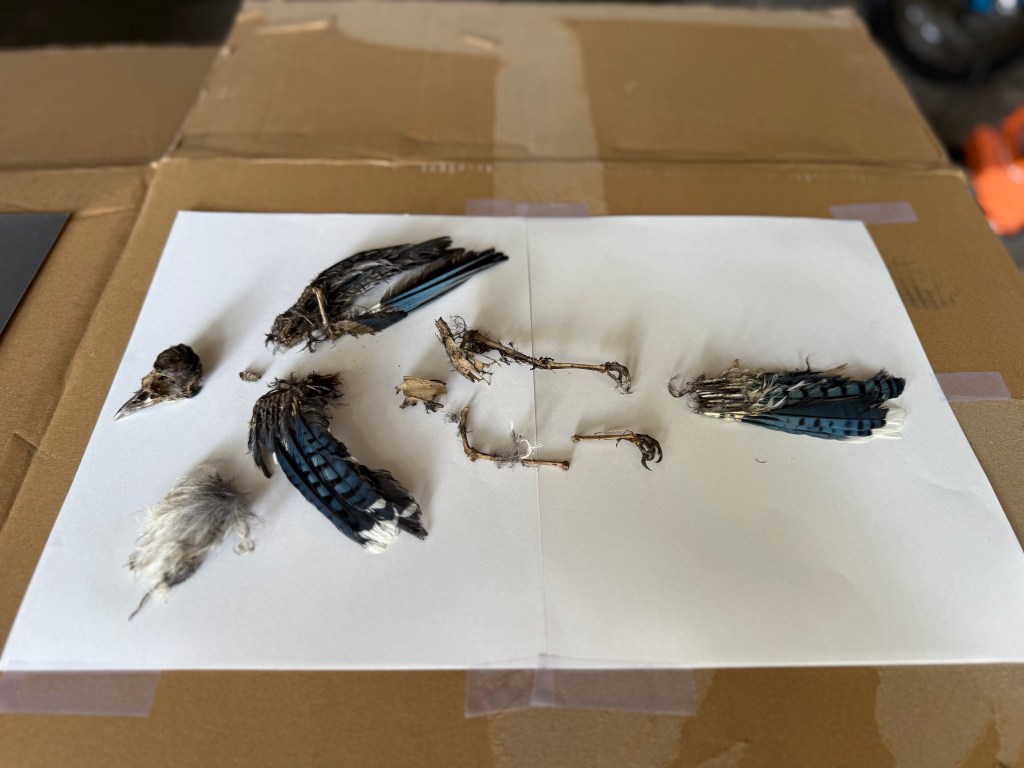
I found a dead Blue Jay in my backyard at the beginning of August. I’m uncertain about how it died, maybe West Nile virus. However, this story won’t be about viruses or death. This story will be about bird bones. Yes, that’s right. Avian osteology if you’re a scientist. And if you’re a hobbyist, “vulture culture.”
According to the world wide web, vulture culture “is a subculture of people who ethically collect, clean, and preserve animal remains (like bones, feathers, etc.) often for art, education, or personal interest.”
I knew nothing about vulture culture prior to writing this post, and I still don’t. But what I do know is that when I saw that dead Blue Jay I was very sad, and then I was very curious. I wanted to use the experience to learn whatever I could.
If you’re like me, you might lie awake at night and ask yourself “is it legal to keep a dead Blue Jay?” And the answer is sort of. The Migratory Bird Treaty Act only allows for possession of bird parts in certain circumstances. Effective December 31, 2024 the U.S. Fish and Wildlife Service published a regulatory authorization that established criteria for bird possession without requiring a permit. In my case, I was able to collect and keep the Blue Jay remains for up to seven calendar days per the Salvage clause of 50 CFR 21.16. Within seven calendar days the salvaged specimens must be donated or destroyed. See the U.S Fish and Wildlife Service website for more detail.
I waited just over a month from when I found the Blue Jay to when I collected it. This was purposeful. Firstly, it gave me time to do my research on bird permits. I also did some googling to get some ideas on what to do with the bird’s bones and feathers. This is when my eyes opened to the world of skeleton articulation. I never quite understood the fascination with skeletons, but now I do. I watched this YouTube video of a person align an eye bone (sclerotic ring) inside of a Northern Cardinal skull. Did you know that there was such a thing as an eye bone in a bird’s skull before reading this? Yeah, kinda neat.
The most important purpose of the waiting period was for natural decomposition. I didn’t want to deal with flesh. I was interested in the bones and feathers.
The day came when I was ready to collect the bird. I wasn’t certain what I would do with it. I decided I would start by picking it up and looking at it. There was a lot of dirt and leaves stuck to its feathers. Seemed like a good next step to get the dirt off. After that, I was left with what seemed like a fully intact skeleton and feathers. One of the legs broke away from the skeleton so I took a closer look at that. Very tiny and light weight.
That’s when I noticed its foot. Compared to the leg bone, the Blue Jay foot seemed so…alive? Covered in scales. Tiny talons intact. Bird feet are cool. Have you seen an American Coot’s toes? Or the talons of an owl? They are hard to miss. Looking at a bird’s feet also remind me of their ancestry, theropod dinosaurs.

I also took a close look at the skull. One of the sclerotic rings was still attached via some matted feathers. When I pulled away some feathers the vertebrae detached.
At this point I was left with all the individual parts of the bird. The feet, a skull, the legs, a wing connected to the rib cage, another wing, and the tail feathers. That seemed like enough investigation for one day. I put the remains in a box and put the box in the garage. A few days later I got the box out. I decided I wanted to take some photos and then dispose of the bird.
Taking photos of bird bones and feathers in the outdoors is tricky. They are so light weight that the slightest breeze could have blown them away. I set up a makeshift bench in the garage, and there was just enough natural light to get a few snapshots.
This experiment isn’t something I thought I would ever do. Dead animals are gross. But, my love for learning about birds has me doing things I wouldn’t think I would do. Would I do it again? Probably not. Well, maybe for another bird species…
 Being & Birds
Leave a comment